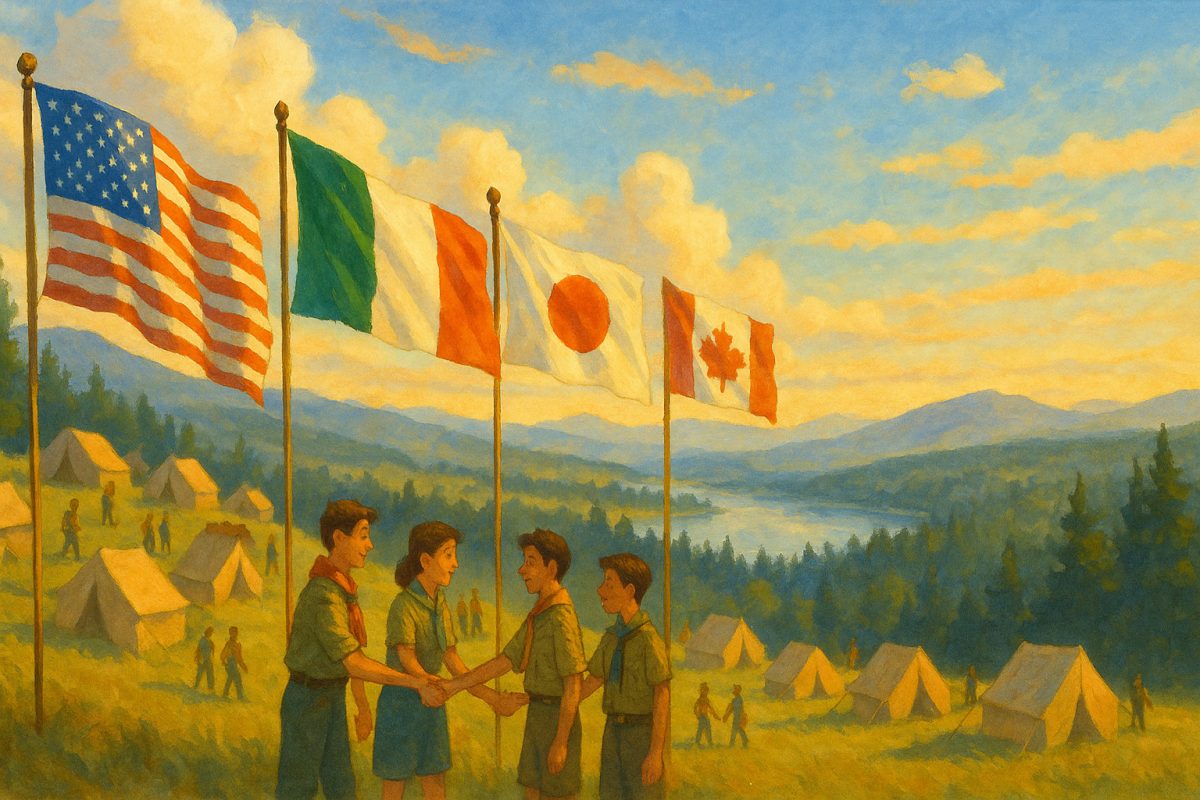
Scouting is about adventure, learning, and meeting new friends from all over the world. The World Scout Jamboree brings these ideas to life, offering Scouts a chance to gather, share stories, and experience different cultures together. Each Jamboree is a celebration of what makes Scouting special: friendship, teamwork, and the spirit of discovery.
Learning the Jamboree’s history reveals how it has brought together Scouts from different countries for over a century. In this article, you’ll find out how the World Scout Jamboree started, how it’s evolved, and what makes it so important to Scouts today. Whether you’re a Scout, parent, or leader, this history reveals the true significance of the event.
What is the World Scout Jamboree?
The World Scout Jamboree is a worldwide gathering of Scouts, held every four years in a new host nation. It unites thousands of young people and leaders for days of camping, activities, and cultural exchange. The event builds international friendship and cooperation, reflecting Scouting’s core values.
Scouts have gathered for the World Scout Jamboree since 1920. The first event took place from July 30 to August 8, 1920, at the Olympia in Kensington, London, England. More than 8,000 Scouts from 34 countries took part, making it the first global Scouting event of its kind.
Lord Robert Baden-Powell, founder of Scouting, modeled the Jamboree after the Olympic Games as a way to unite young people from every nation. The Olympia venue in London reflected this vision of a peaceful international gathering despite differences in background or culture.
Watching historic Jamboree footage reveals the spirit that has defined these events for over 100 years. The documentary below captures the friendships and cultural exchange that make Jamborees special for Scouts.
The 1967 National Boy Scout Jamboree in Idaho brought together Scouts from across the country for action-packed activities, friendship, and cultural exchange. Scouts enjoyed trading, participating in outdoor adventures, and developing skills, while also discussing social issues and environmental responsibility. Highlights of the 1967 National Jamboree in Idaho included special guests, large performances, and a closing candlelight ceremony that united Scouts as one troop. The event demonstrated that Scouts share a vision for a peaceful world, despite their diverse backgrounds.
The Meaning of “Jamboree”
Lord Robert Baden-Powell chose the word “Jamboree” to describe these global gatherings. It reflects the spirit of celebration and togetherness that defines the event. The term refers to a large, joyful gathering, underscoring the value of coming together as a global community.
Baden-Powell wanted a word that captured both the festive nature of the event and its deeper purpose of uniting young people from different nations. The choice of “Jamboree” perfectly encapsulates the blend of fun, learning, and international brotherhood that these gatherings represent. When Scouts return home from a Jamboree, they carry memories of activities and adventures along with a broader understanding of their place in the global Scouting family.
Today, World Scout Jamborees bring together tens of thousands of Scouts from over 150 countries and territories. Each event continues Baden-Powell’s vision, adapting to new opportunities and challenges for each new generation.
Origins and Early History
The Birth of Scouting and International Vision
Scouting began in 1907 when Lord Robert Baden-Powell ran the first Scout camp on Brownsea Island, England. The idea caught on quickly and inspired him to envision a global gathering of Scouts, one that would demonstrate to the world that young people could transcend boundaries and form genuine friendships.
The idea of a World Jamboree originated from Baden-Powell’s dream of unity among Scouts as more Scout groups formed worldwide. As they recognized the need for an event where Scouts could meet face-to-face and feel part of a global movement, the concept evolved. The idea gained momentum as Scout groups formed in countries around the world. Baden-Powell recognized that these international connections needed a physical meeting place, somewhere Scouts could experience firsthand what it meant to be part of a global movement.
The First Jamboree: 1920, London
The first World Scout Jamboree was set for 1917 to celebrate Scouting’s tenth year, but World War I postponed those plans. When the war ended, organizers sought to convey a message of hope and peace through the event. When peace finally returned, organizers were determined to make the event even more meaningful. The Jamboree was held from July 30 to August 8, 1920, at Kensington Olympia in London, a massive glass-roofed building that required a foot of Earth and turf to be laid on the floor to create an indoor camping experience.
Eight thousand Scouts from 34 countries attended this historic gathering. For many participants, it was their first time meeting someone from another continent, let alone camping alongside them. The choice of Olympia was deliberate. It echoed the ancient Olympic Games and symbolized the same spirit of international competition and friendship that the modern Olympics had revived.
The 1920 Jamboree stood out for its size and timing. Europe was recovering from World War I, and Scouts from former enemy nations camped together, shared meals, and learned new songs. The event showed that Scouting values can help young people form friendships, even in the years following conflict.
| Year | Location | Attendance | Number of Countries |
|---|---|---|---|
| 1920 | London, UK | 8,000 Scouts | 34 |
The Four-Year Cycle and Wartime Interruptions
The success of the 1920 jamboree sparked discussions about making these gatherings regular events. Konstantinos Melas of Greece proposed adopting the Olympic model of holding jamborees every four years. Baden-Powell embraced this idea because he understood that regular contact between international Scout groups would strengthen the bonds of friendship and prevent the kind of misunderstandings that had led to global conflict.
This four-year cycle worked well through the 1920s and 1930s, with jamborees held in Denmark (1924), the United Kingdom (1929), Hungary (1933), and the Netherlands (1937). However, World War II interrupted this rhythm, and no jamborees were held between 1937 and 1947. The gap in Jamborees during World War II reminded Scouts how easily international friendships can be disrupted, and how important it is to rebuild those bonds when peace returns.
Individual participants often share the most powerful stories about jamboree history, complementing official records. These personal accounts reveal how a week of camping together could change a Scout’s entire worldview, turning abstract concepts like “international friendship” into real relationships with names and faces. Many attendees from the early jamborees maintained lifelong correspondences with Scouts they met, creating networks of friendship that lasted decades beyond their Scouting years.
Growth and Evolution of the Jamboree
Expanding Participation and Locations
The World Scout Jamboree has transformed from a modest gathering of 8,000 Scouts in London to a massive international celebration that spans continents. Modern Jamborees regularly host over 40,000 participants from more than 150 countries, making them among the largest youth gatherings on Earth. The 2019 Jamboree in West Virginia set the attendance record with over 45,000 members experiencing the adventure together.
These events have taken Scouts to nearly every corner of the globe. From the mountains of Austria to the plains of Korea, each location brings its character to the Jamboree experience. The host country’s culture is part of every activity, whether it’s traditional Korean music performances or Japanese tea ceremonies, creating a blend of local heritage and the shared spirit of Scouting worldwide.
The variety of countries at each Jamboree means that Scouts learn how Scouting fits into different cultures, while still adhering to the same values. A Scout from Kenya and one from Canada might tie different knots or cook different camp meals, but they share the same commitment to being trustworthy, loyal, and helpful.
Notable Jamborees and Milestones
The 1947 Jamboree in France marked a turning point for the movement. This first post-World War II gathering symbolized renewed hope and international cooperation, bringing together young people from nations that had recently been at war. Former enemies camping together showed how Scouting can bridge political divides.
The 23rd World Scout Jamboree in Japan (2015) focused on “A Spirit of Unity,” hosting 33,628 Scouts from around the world. The Japanese organizers emphasized peace and sustainability, incorporating environmental education into every program area. Scouts learned traditional Japanese crafts alongside modern conservation techniques, creating a perfect blend of cultural heritage and forward-thinking ecological stewardship.
The 24th Jamboree in West Virginia (2019) took “Unlock a New World” as its theme, emphasizing leadership development and outdoor adventure. The 2019 Jamboree offered one of the most varied programs in event history, with activities ranging from whitewater rafting to robotics workshops. The event proved that modern Jamborees could honor Scouting’s outdoor roots while embracing technology and innovation.
Experiencing a World Scout Jamboree creates memories that last a lifetime, and hearing from past participants helps capture the true spirit of these incredible gatherings. The video below showcases highlights from the 25th World Scout Jamboree in South Korea, featuring Scouts sharing their favorite moments and the friendships they formed during the event.
Over 43,000 Scouts from 158 countries attended the 25th World Scout Jamboree in South Korea, celebrating global friendship and cultural exchange. Even with a heatwave and Typhoon Khanun, the event adapted into a travelling Jamboree across South Korea. Scouts explored Korean culture and participated in various activities before reuniting for a grand closing ceremony, which included a K-POP concert. The Jamboree showcased the Scouts’ resilience, unity, and the formation of lasting friendships.
The Educational Mission
Jamborees serve as intensive leadership laboratories where young people develop skills they’ll use throughout their lives, going beyond large camping trips. The educational mission centers on three core areas: practical outdoor skills, cultural competency, and global citizenship. Every activity is designed to challenge Scouts while building their confidence and expanding their worldview.
The outdoor skills component stays true to Scouting’s roots. Scouts master advanced camping techniques, learn wilderness survival skills, and tackle challenging adventure activities. These are carefully structured learning opportunities that build problem-solving abilities and teamwork skills while also providing. When a patrol from different countries works together to create a pioneering project, they face the challenge of working as one team. In doing so, they learn to communicate across language barriers and cultural differences.
Cultural exchange activities form the heart of the Jamboree experience. Scouts participate in international friendship ceremonies, share traditional foods from their home countries, and learn about different customs and traditions. These interactions break down stereotypes and build understanding between young people who might otherwise never meet. A Scout from rural Montana might discover that a Scout from urban Tokyo shares the same passion for hiking and environmental conservation.
Service projects at Jamborees demonstrate Scouting’s commitment to making the world a better place. Whether building playgrounds for local communities or participating in environmental restoration projects, Scouts learn that leadership means taking action to help others. These projects often continue long after the Jamboree ends, with Scouts maintaining connections and supporting ongoing community development efforts.
The leadership development aspect of Jamborees happens both formally and informally. Scouts serve as patrol leaders, activity coordinators, and cultural ambassadors, gaining real-world experience in managing teams and solving problems under pressure. They learn that effective leadership requires adapting your approach to work with people from different backgrounds and communication styles. This skill proves invaluable whether they’re leading a high school project team or managing a workplace initiative years later.
The Lasting Impact of the World Scout Jamboree
The World Scout Jamboree creates ripple effects that extend far beyond the event itself. The weeks at a World Scout Jamboree can shape how young people see the world and their role in it for years to come. The connections formed and lessons learned become foundational elements in developing confident, globally-minded leaders.
Building International Brotherhood
Scouts form lifelong friendships that transcend borders, languages, and cultural differences at Jamborees. These connections go beyond casual acquaintances and are built through shared experiences and teamwork. Many participants maintain these friendships for years, creating a global network of peers who share common values and experiences.
The event structure naturally encourages respect, understanding, and cooperation among young people from vastly different backgrounds. When a Scout from Kenya teaches traditional games to peers from Canada and Japan, or when teenagers from different continents collaborate to build a community garden, they develop an appreciation for diversity that textbooks cannot provide. These interactions help Scouts break down stereotypes and form lasting friendships.
Research from the World Organization of the Scout Movement indicates that participants in Jamborees consistently report increased cultural awareness and enhanced global citizenship skills. Shared Scout values, such as trustworthiness, loyalty, and helpfulness, create common ground for meaningful connections, even across language and cultural differences.
Shaping Future Leaders
Many Jamboree participants go on to become leaders in their communities, countries, and international organizations. The confidence gained from successfully navigating a massive global event, combined with the leadership skills developed through Jamboree activities, creates a foundation for lifelong leadership success. Former participants often credit their Jamboree experience as a turning point in recognizing their potential.
The experience helps young people build confidence by exposing them to new challenges and diverse perspectives. When a Scout successfully leads a mixed-nationality patrol through a challenging outdoor activity or facilitates a cultural exchange workshop, they discover capabilities they didn’t know they possessed. This self-discovery often becomes the catalyst for pursuing leadership roles in school, community organizations, and eventually their careers.
The Jamboree environment teaches participants to see diversity as a strength. Working alongside peers from different cultures, economic backgrounds, and life experiences shows Scouts how varied perspectives can lead to more creative solutions and stronger teams. This lesson proves invaluable as they advance in their education and careers.
Many Scouts find that the connections they make at Jamborees open doors to future travel, study, and service opportunities they never expected. A friendship formed during a service project might lead to an invitation to visit another country, participate in an international exchange program, or collaborate on global service initiatives years later. These opportunities can shape future goals and choices for Scouts, sometimes in surprising ways..
The leadership development that occurs at Jamborees is particularly powerful because it happens in a supportive, values-based environment. Scouts practice leading diverse groups while being guided by the Scout Oath and Law, creating leaders who prioritize service, integrity, and respect for others. This foundation of ethical leadership becomes increasingly valuable as participants advance to positions of greater responsibility in their adult lives.
Quick Takeaways
- The World Scout Jamboree stands as one of Scouting’s most significant traditions, connecting young people across continents since 1920. The first Jamboree took place at London’s Olympia, bringing together 8,000 Scouts from 34 countries, marking a defining moment for the global Scouting movement.
- The event’s founders drew inspiration from the Olympic Games, establishing a four-year cycle that remains in place today. This timing allows each generation of Scouts to experience the Jamboree during their prime Scouting years, typically between ages 14 and 17. The four-year schedule creates anticipation and gives Scout groups time to prepare thoroughly for what many consider the adventure of a lifetime.
- Like the Olympics, Jamborees have faced interruptions during major global conflicts. World War II caused cancellations, but the tradition resumed after the war. The desire for international friendship and understanding brought Scouts back together.
- Participation has grown dramatically from those original 8,000 attendees to tens of thousands of Scouts representing nearly every nation with active Scouting programs. Recent Jamborees have welcomed over 40,000 participants, making them among the largest youth gatherings in the world. This growth reflects both Scouting’s expansion and the growing recognition that global citizenship begins with young people connecting across cultures.
- The Jamboree’s core mission remains unchanged: promoting friendship, leadership development, and global understanding through shared adventure and service. Scouts return home with a broader world view, stronger leadership skills, and friendships that last for decades. Many Scouts say the Jamboree inspires them to be more active in their communities and the world.
- Today’s Jamborees continue building the worldwide Scouting community that Baden-Powell envisioned over a century ago. Each event strengthens the bonds between national Scouting organizations and demonstrates that, given the opportunity, young people naturally gravitate toward cooperation rather than conflict.
Frequently Asked Questions
What is the purpose of the World Scout Jamboree?
The World Scout Jamboree serves as Scouting’s premier international gathering, uniting young people from diverse countries and cultures under the shared values of the Scout Movement. The primary goal is to foster international friendship, promote peace, and strengthen the global Scout community through shared experiences and cultural exchange. According to the World Organization of the Scout Movement, these events provide participants with once-in-a-lifetime opportunities to develop leadership skills, build lasting friendships across borders, and gain a deeper understanding of global citizenship.
The Jamboree also serves as a platform for Scouts to engage with contemporary global challenges, such as sustainability, peace-building, and community service. Participants return to their home countries as ambassadors of international understanding, carrying forward the spirit of global Scouting cooperation.
Who can attend the World Scout Jamboree?
Scouts aged 14 to 17 at the time of the event are eligible to participate as attendees, provided they are members of organizations belonging to the World Organization of the Scout Movement (WOSM). This age range ensures participants are mature enough to handle the international travel and cultural immersion while still being young enough to benefit from the youth-focused programming.
The selection process varies by country, but typically involves application through your national Scout organization. In the United States, Scouts apply through Scouting America’s international programs, which manage the selection and preparation of the national contingent. Adult leaders aged 18 and older can also participate as International Service Team members, providing support and supervision for the youth participants.
How often is the World Scout Jamboree held?
The World Scout Jamboree follows a four-year cycle, inspired by the model established by Scouting founder Robert Baden-Powell for the Olympic Games. This schedule allows sufficient time for planning, fundraising, and preparation while maintaining regular opportunities for international gatherings. The tradition began in 1920 with the first Jamboree in London, which brought together 8,000 Scouts from 34 countries.
The four-year cycle aligns with the ages of most Scouts, allowing many to attend a Jamboree during their Scouting years. Recent Jamborees have welcomed tens of thousands of participants, making them massive logistical undertakings that require years of planning.
Why was there no Jamboree during World War II?
World War II created impossible conditions for international youth gatherings, leading to the cancellation of what would have been the 6th and 7th World Scout Jamborees. The global conflict made international travel dangerous, if not impossible, and many countries were focused entirely on wartime efforts rather than youth programs. Additionally, many Scout leaders and older Scouts were serving in military roles, leaving Scout organizations with reduced capacity to organize such large-scale events.
The war years from 1939 to 1945 represented a significant interruption in the Jamboree tradition, but the Scout Movement resumed international gatherings as soon as conditions allowed. The 6th World Scout Jamboree was eventually held in France in 1947, marking the triumphant return of international Scouting cooperation in the post-war era.
How has the Jamboree changed over time?
The evolution of the World Scout Jamboree reflects both the growth of the global Scout Movement and changing approaches to youth development. The first Jamboree, held in 1920, hosted 8,000 participants, while modern Jamborees regularly welcome 40,000 or more Scouts from over 150 countries. This growth has required more advanced planning, bigger venues, and more complex activities.
Modern Jamborees place a greater emphasis on global issues such as sustainability, peace-building, and cultural understanding.
Recent events have incorporated advanced technology, environmental consciousness, and structured leadership development programs that go far beyond the camping and outdoor activities that dominated early Jamborees. The programming now includes workshops on global citizenship, service projects addressing local community needs, and structured cultural exchange activities.
Despite these changes, the core mission remains unchanged: to bring together young Scouts, build friendships, develop leadership skills, and strengthen the global Scout community.
The venues have also evolved significantly. While early Jamborees were held in existing facilities like London’s Olympia, modern events require purpose-built temporary cities with sophisticated infrastructure for housing, feeding, and entertaining tens of thousands of young people.